
Battle UI – Flank and Guard
The Battle UI for Group Skirmishes has changed a lot over the years a long with the mechanic itself. The Flank and Guard mechanic is progression of the way Dual strikes and Dual guard worked in FE Awakening and Fates. Flanking allows units that are surrounding an enemy unit in the cardinal directions (Up, Down, Left, Right) to join in an attack. This creates unit interactions of up to 5 concurrent units. Below shows a “3vs2” scenario, where 3 player units will each attack a single enemy unit.
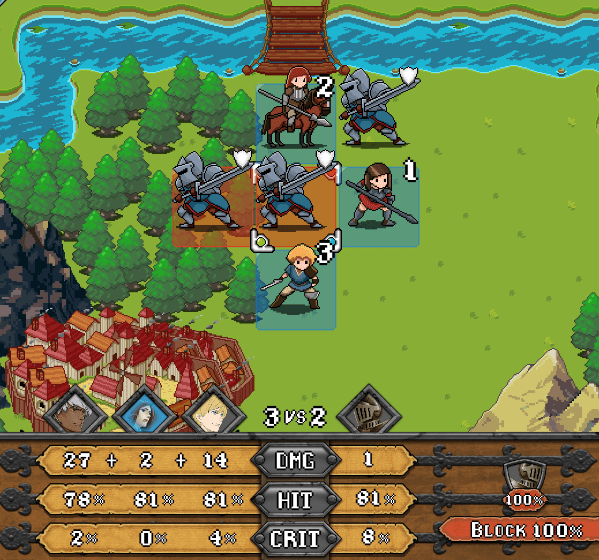
Flanking aims to:
- Flank attacks are a way for all participating units to build support EXP with each other.
- Replace double attacks. I personally never liked the arbitrary requirements for double attacks (5 speed above defending unit). Double attacks did enhance the game experience by speeding up combat and having 2 chances to Crit, which was a generally satisfying mechanic for players.
One thing that is pending the order of which the attackers begin their attack, and the EXP distribution for each participant, which are things that will affect game balance alot.
Guard/Blocking
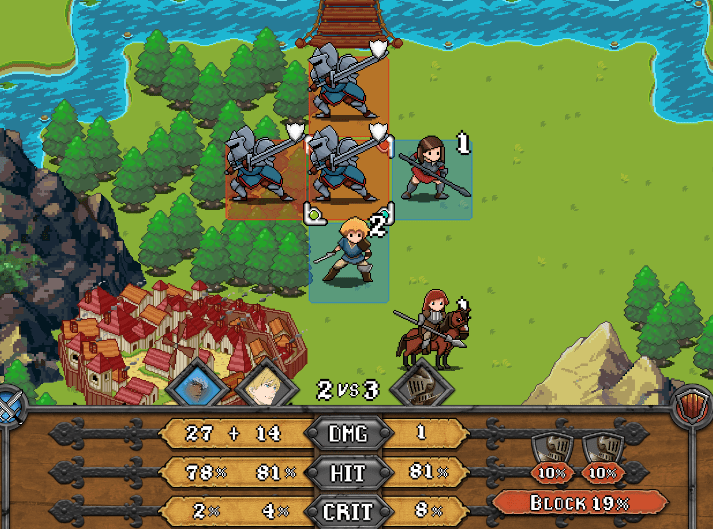
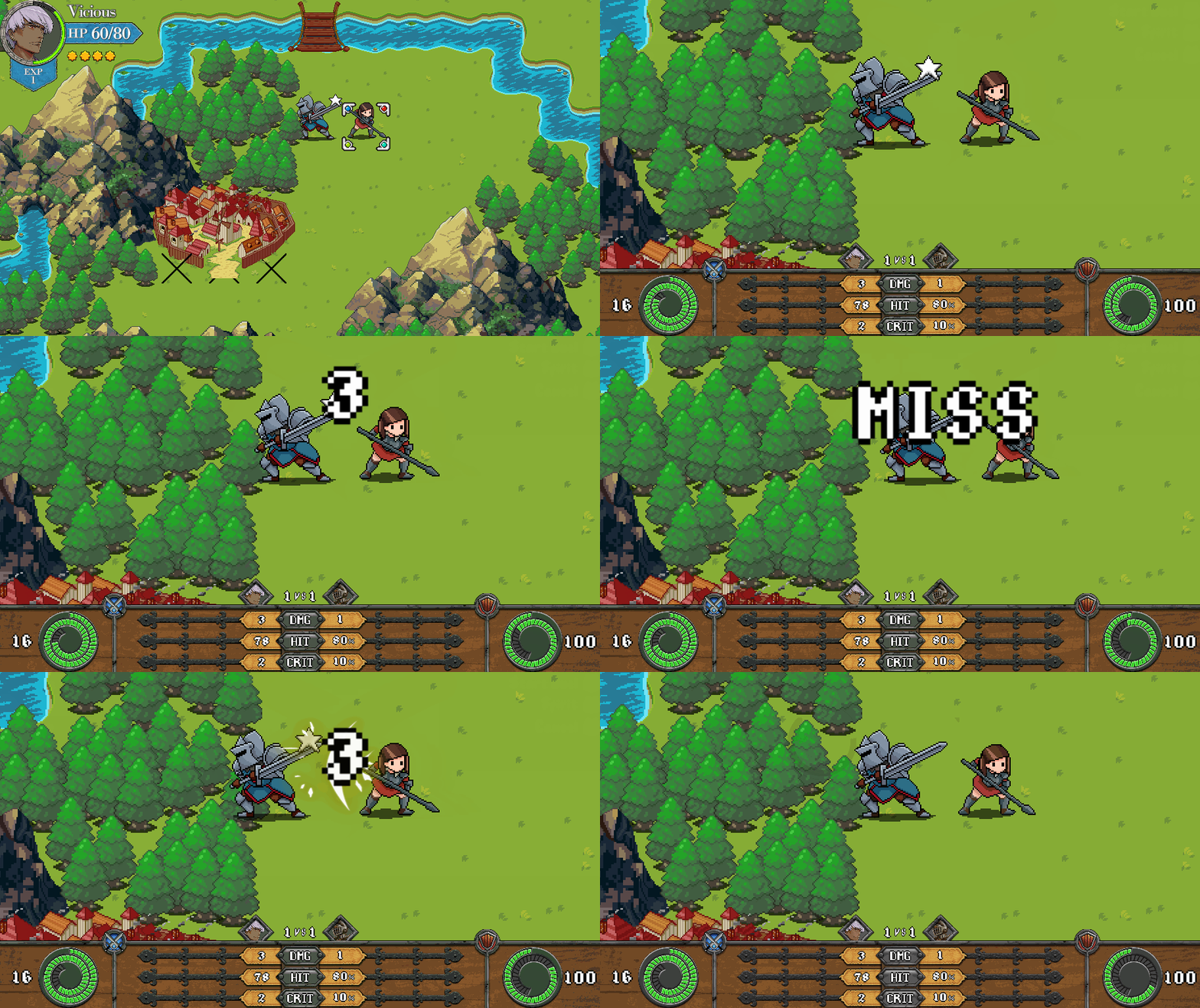
For any unit being attacked, any allied units in adjacent squares contribute to an overall chance to Block/guard. This means that for any attack that would hit (not miss), each blocker will calculate a chance to block. What is displayed on the battle UI is the overall chance for any attack to be blocked (19%). Should a block/guard trigger, all damage is negated.
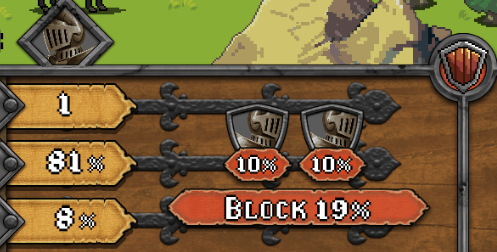
Due to the Rest/Heal mechanic only working when there are no enemy units in attack range, guarding damage is the primary way to conserve your parties HP pool. Taking advantage of guard/block and building support between units becomes extremely important later into the game as high support levels can cause a group of 3 player units standing next to each other to provide very high block rates for one another.
I had a lot of initial reservations with increasingly the complexity of combat interactions as it makes sense that most people don’t want to read through tables and charts of numbers that may seemingly come from nowhere. That seems to be the design trend in FE games as the dual mechanics were removed from future installments, and complexity was added to class systems instead of map interactions. The main trade-off of the more complex design, and that I liked about the dual system was the satisfaction of units blocking for one another, which added an additional layer of fantasy to making support between units meaningful, both mechanically and narratively.
At this point in the design, the hope is to alleviate some of that complexity through simplified UI. For most players and situations, the battle UI should just explain whether the combat will be good or bad for the player. It will mostly likely make sense down the road to purposefully hide combat information that is distracting from helping the player make a decision.

Dueling
A system called dueling is added to the base gameplay loop that is available on “Commander” type enemies. It behaves essentially as an adaptation of the arena system from FE games, where 2 units battle until one is defeated. Unlike an arena battle, there is no ability to forfeit mid battle, so duels are considered high risk/high reward. Winning duels increases a Duels Won counter tied to the specific unit that was used and also provides additional Bounty Silver once the level is complete.
The Dueling System aims to:
- High Risk/High reward side objectives
- Contributes to overall Unit customization
- Additional Narrative Elements
The criteria for a duel to take place is fairly strict. The option to duel an Enemy commander will not appear if they have taken any damage from player units or been attacked. This prevents the player from dealing regular combat damage to a commander and then dueling to easily claim the bounty rewards.
Duel Draws
There exists scenarios where 2 units dueling may have a combination of low hit rate and low damage that may cause the duel to possibly drag on forever. Currently there is a 20 attack max count to create a “Duel Draw” situation.
Enemy Platoons

Duels are against “Commanders” and some of these Commander type units are surrounded by “subordinate” units. Winning a duel provides a route to avoid having to fight every individual unit. Winning a duel against the commander will cause each subordinate unit to surrender afterwards. In addition to granting EXP and WEXP like a normal battle, winning duels will grant Reknown based on the relative bounty of that commander.

Attacking Surrendered Units
When Enemy Units surrender from their commander being defeated, they remain permanently idle until the level is over. These units can still be attacked and will die in a single hit, with a 100% hit chance. Doing so will still grant EXP and WEXP but increase the players Infamy. The design of the infamy mechanic tends to lean towards giving rewards to the player immediately in exchange for disadvantages later on.
Unit Titles
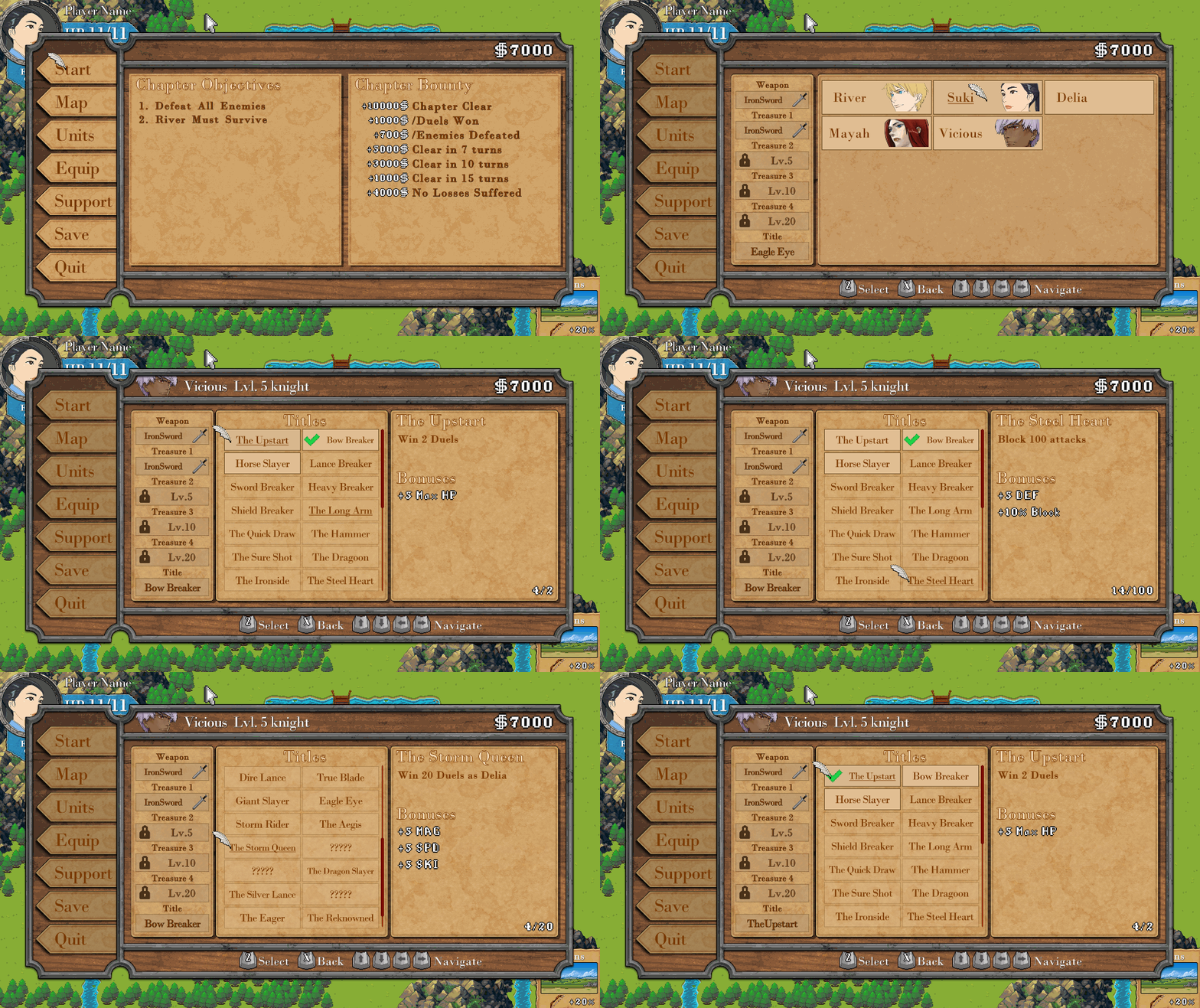
To compliment the dueling mechanic, the “Titles” system is added a reward system around duels which allows passive bonuses to be equipped to Units.
Titles are a progression on equippable passive skills seen in FE games. In FE games, skills that provided passive bonuses (+10 hit and +10 avoid) were usually locked to characters or classes for narrative purposes. These passive bonuses are now obtained by any unit through side objectives.
The Titles system aims to:
- Help players feel their characters are unique from one another
- Add to player units narratively. (story is unlocked by certain units getting certain titles)
- Be a sort of minigame within the game, similar to training a metapod in pokemon,
- Additional way to make your units much stronger
- Additional incentive to duel strong optional enemies to claim their titles.
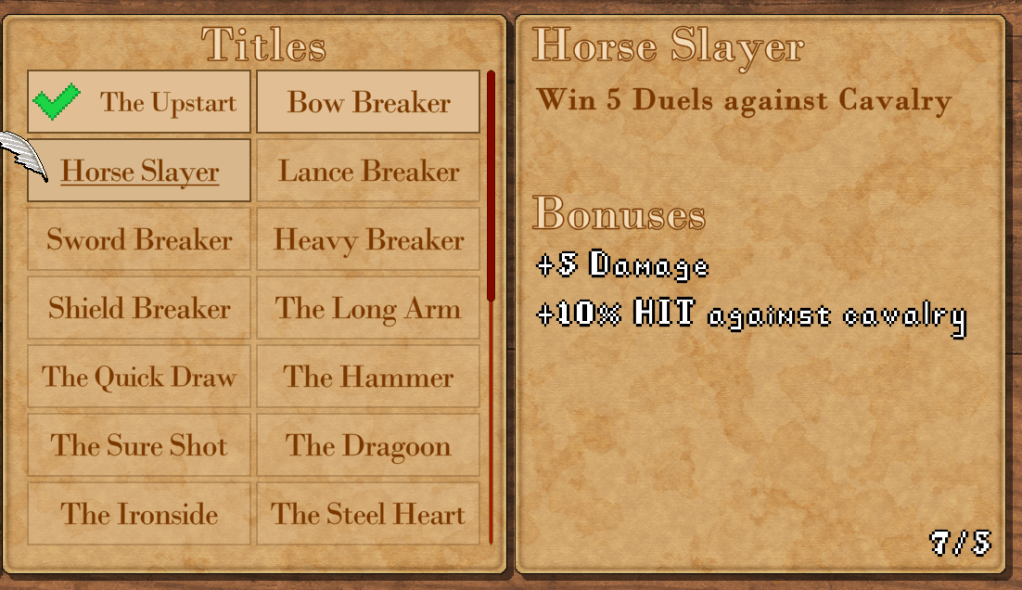
The Title List will show all available titles that have been earned as well as the ones yet to be earned. This screen is meant to help players decide what bonuses they want to pursue and how close they are. Units can equip one of the titles from the list that they have earned, and this title is shown on their stat screen.
Unit Stat Screen UI
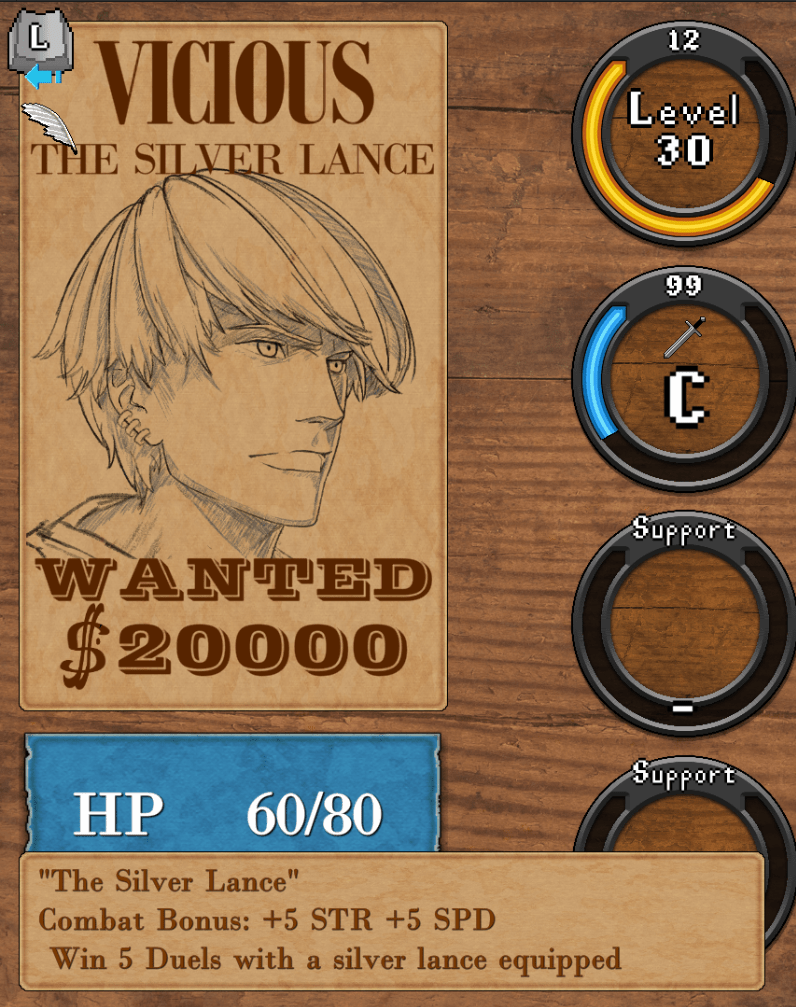
Character Bounty and Titles
The dueling and titles system are both meant to add to character customization narratively and the Character UI is meant to capture this. In addition to titles, every character has a Silver Bounty associated with them based off the number of duels and regular battles they participate in. In all party-building tactics games, there’s a few characters that end up being the “favorites”. The bounty system aims to highlight this more obviously as well as change both gameplay and narrative events.
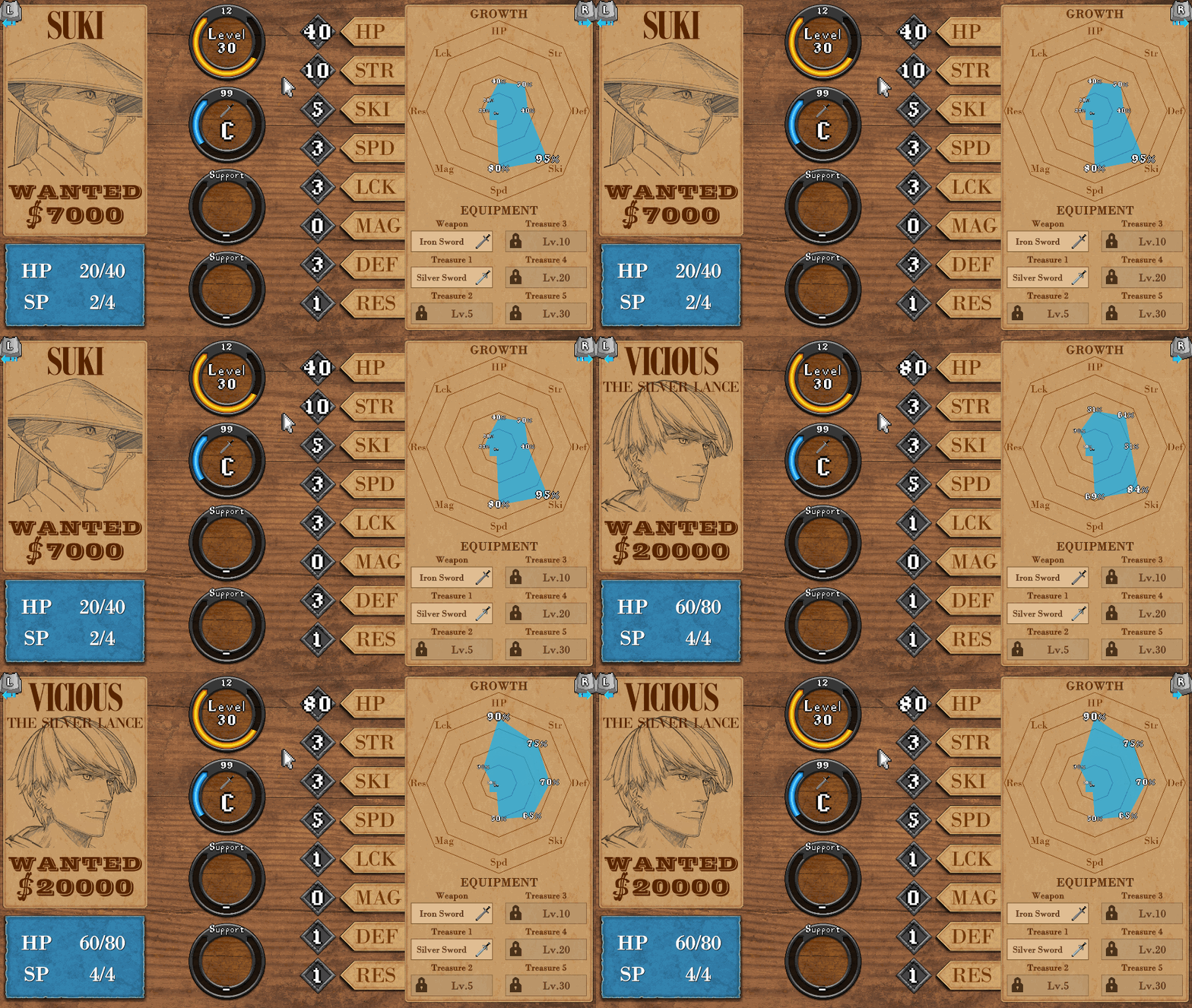
Despite being a very simple screen from the perspective of the player, a lot of time is actually spent by players studying the unit stat screen in RPGs and tactics games. This was another screen that got a lot more raw information and functionality added to it from its traditional FE counterparts. Much like one the unit equipment screens, the Stat growths of units are shown and dynamically change to whichever unit is selected.
This post outlined some of the more significant changes to the traditional base gameplay loop. Basic combat now has Flank/Guard and Dueling added problems for players to solve and how to split and group their units down different paths. Next post will showcase the changes to Chapter Start Unit Selection and the Unit Hiring System that was added.
 To Reverie