
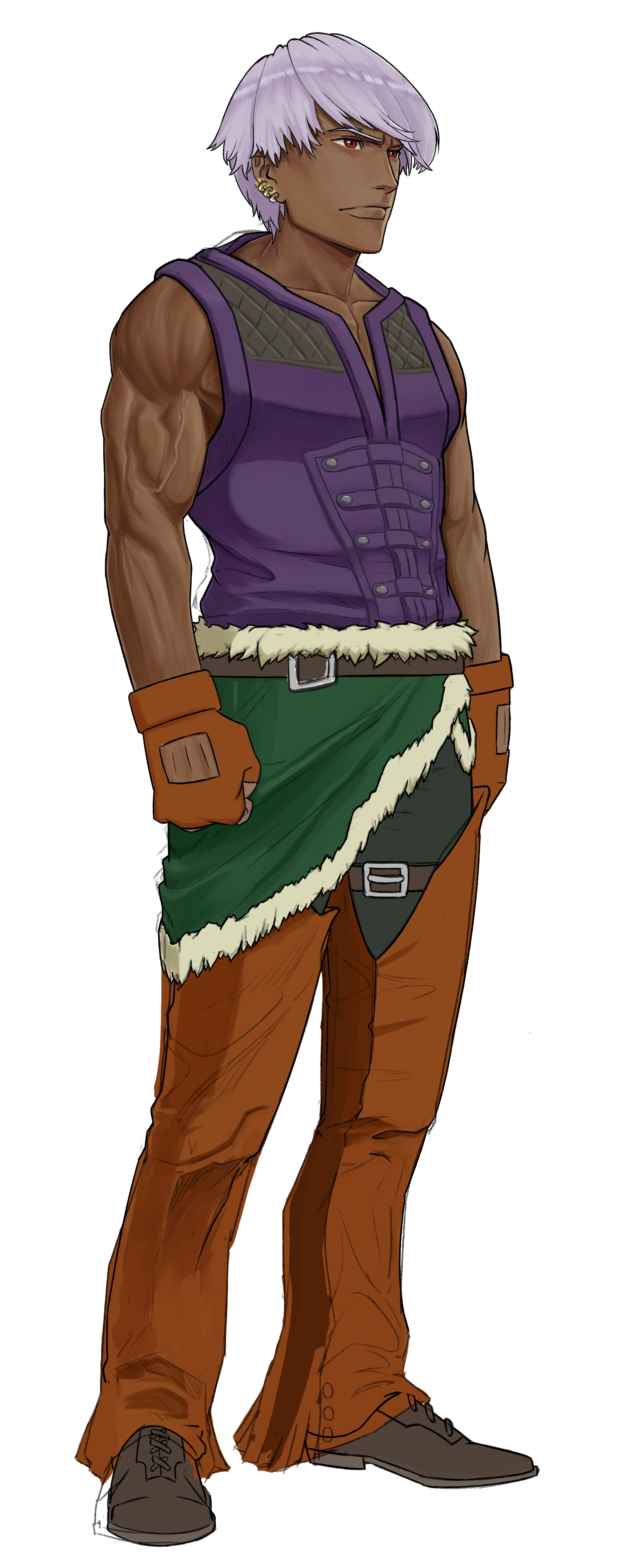
After a 2 year hiatus from posting on this blog, I’ve decided to resume posting to serve it’s original purpose as progress tracking for myself, so that I have old designs to look back on and compare my processes for development and art. It stopped serving that purpose once gif and video editing started to take up too much time every week.
The original idea behind a weekly schedule that was upheld from 2017-2019 was to force myself to get something done regularly. Now programming and art I’ll update it on a topic and completion-basis which has been more productive in the last 2 years working on the game silently.
Gameplay Mechanics and Game Difficulty
This post is mainly focusing on game mechanics that have been added on top of the original fire emblem gameplay loops and systems:
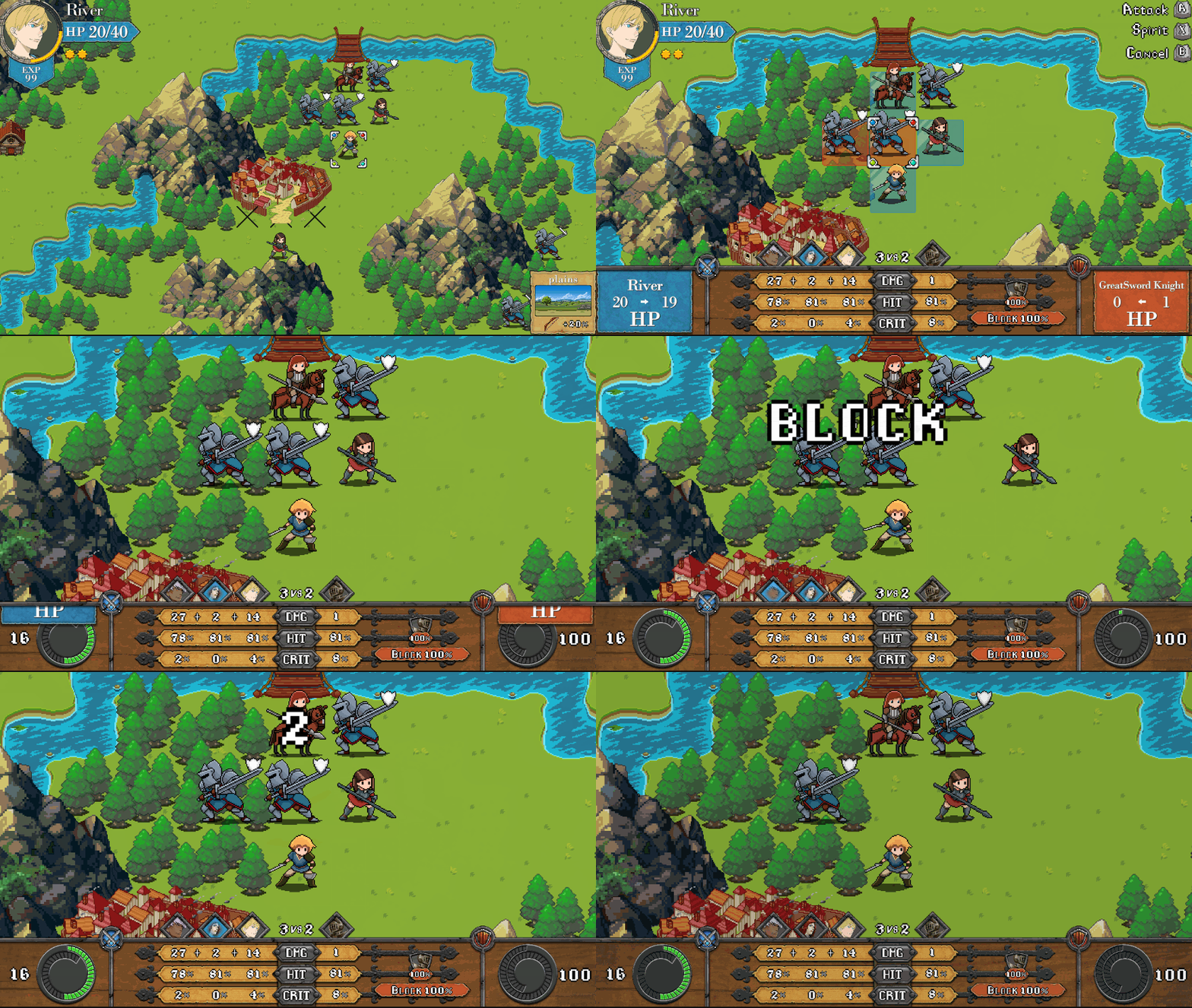
- All controlled units are commanded in a single “turn”.
- Units that are defeated removes them from use, possibly for the entire playthrough.
Game difficulty in modern fire emblem games has typically been to add different modes, that increase the power and/or amount of enemy units on each map. These modes have never appealed to me personally and do not seem interesting to design level/maps around. Addition/change of existing tactics RPG mechanics aims to deal with.
The main philosophy behind these supplementary mechanics its to incentivize players to complete each level with low turn counts as an alternative to difficulty created by having stronger enemy units.
A secondary goal that these mechanics aim to achieve is:
Have a single difficulty setting while simultaneously removing “unwinnable” states in each level.
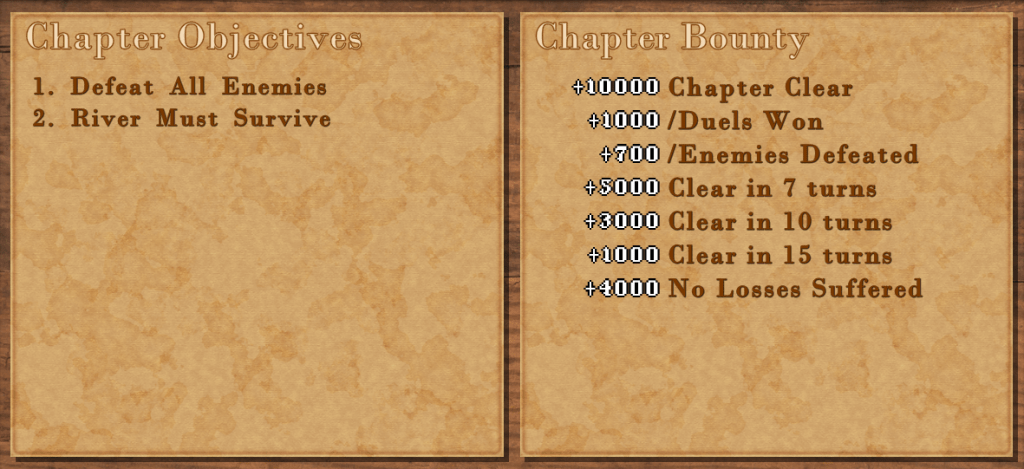
Chapter Bounties
In the above picture a list of player rewards for different optional objectives is shown on the right. These rewards provide the player with the games currency Silver, which can used for a number of things, but mainly to make the player’s unit roster stronger through:
- Hiring/Recruiting new Units
- Buying stronger weapons
The Clear in X turns objectives is a direct push on the player to complete the level quickly, but is balanced with the additional Silver reward of losing no units. This mechanic is geared towards players who wish to min/max their silver output from level to level. Taking advantage of these bounties and having a very strong unit roster is not necessary to being able to complete the game, because of the healing/rest mechanic explained in the section below. Although, having a strong roster that can provide low completion turn counts may affect the story/ending significantly.
Heal/Rest Mechanics
Every controllable unit has the ability to use the “Rest” Command. It heals them for a percentage of their max health and is only available if they are not standing in attack range of any enemy units.
The main idea behind this mechanic is to make the goal of simply being able to clear each level much easier. The player can pull their units back and heal, but at the cost of potentially wasted turns. The heal mechanic is intended to act as a way to recover from mistakes, but the requirement to move a unit back will increase the turn count, making it much harder to get the low turn count bounties.

Spirit Mechanics
Each unit has a resource called Spirit Points (SP) that is used to perform certain movement and combat actions. In the below gif, spirit is used on a selected unit to allow that unit to move further than their movement stat normally allows. The spirit mechanic aims to expand on the willpower mechanic seen in The Banner Saga series.

Spirit can also be used to increase the hit rate and critical chance during battle, providing a choice for players to use it offensively or defensively.
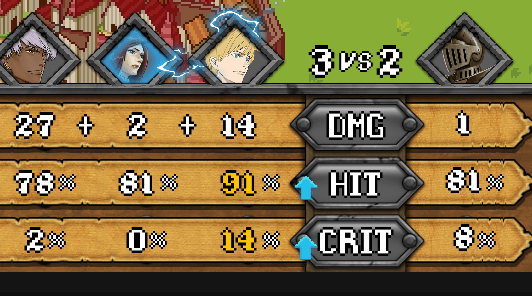
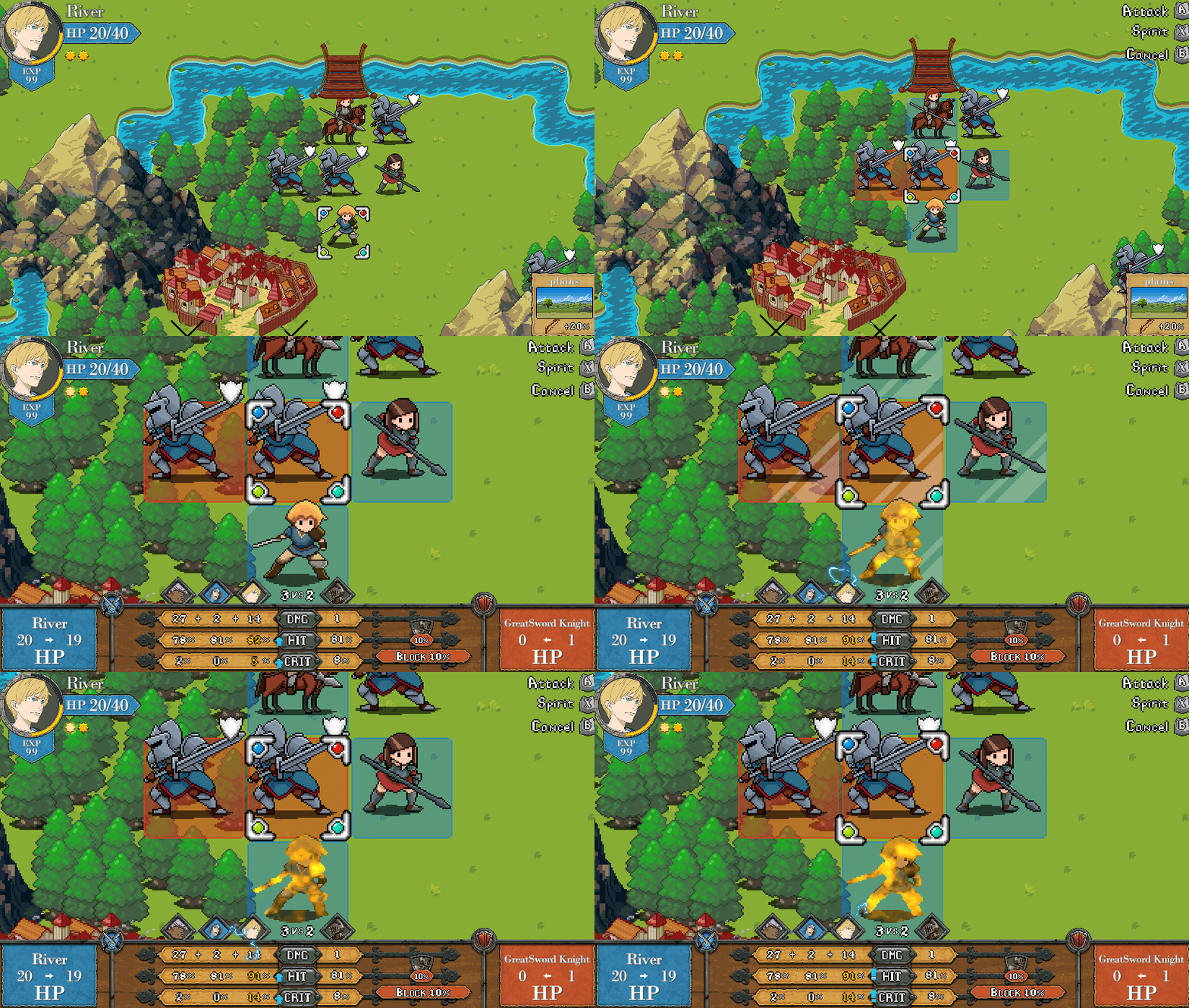
Spirit points are indicated under a units health bar by gold stars. They are replenished at the beginning of every chapter. Just like HP, leveling up increases the maximum spirit capacity of each unit, but as of this post Spirit points will always be sparse, with a maximum of 10 even at the max level (30).
Spirit points aim to be an additional problem solving tool for situations that typically happen in Fire Emblem Games like the ones below:
- Defeating boss/Stronger enemies
- Allowing weaker units to defeat stronger enemies and level them up
- Getting out of bad situations to rest
- Reaching side objectives quickly with stronger units to achieve low turn counts

Destructible Bridges
The image below shows the ability to destroy bridges, creating impassable terrain situations. Any units that are on the bridge will instantly die. This can be used as a gimmicky method to potentially to defeat stronger enemies. As of this post, the unit that destroys the bridge will not gain any EXP if an enemy unit should die from it, to keep the mechanic as purely as defensive one. Destroying bridges will eliminate a direct path, that will most likely increase turn count.

Village Raiding
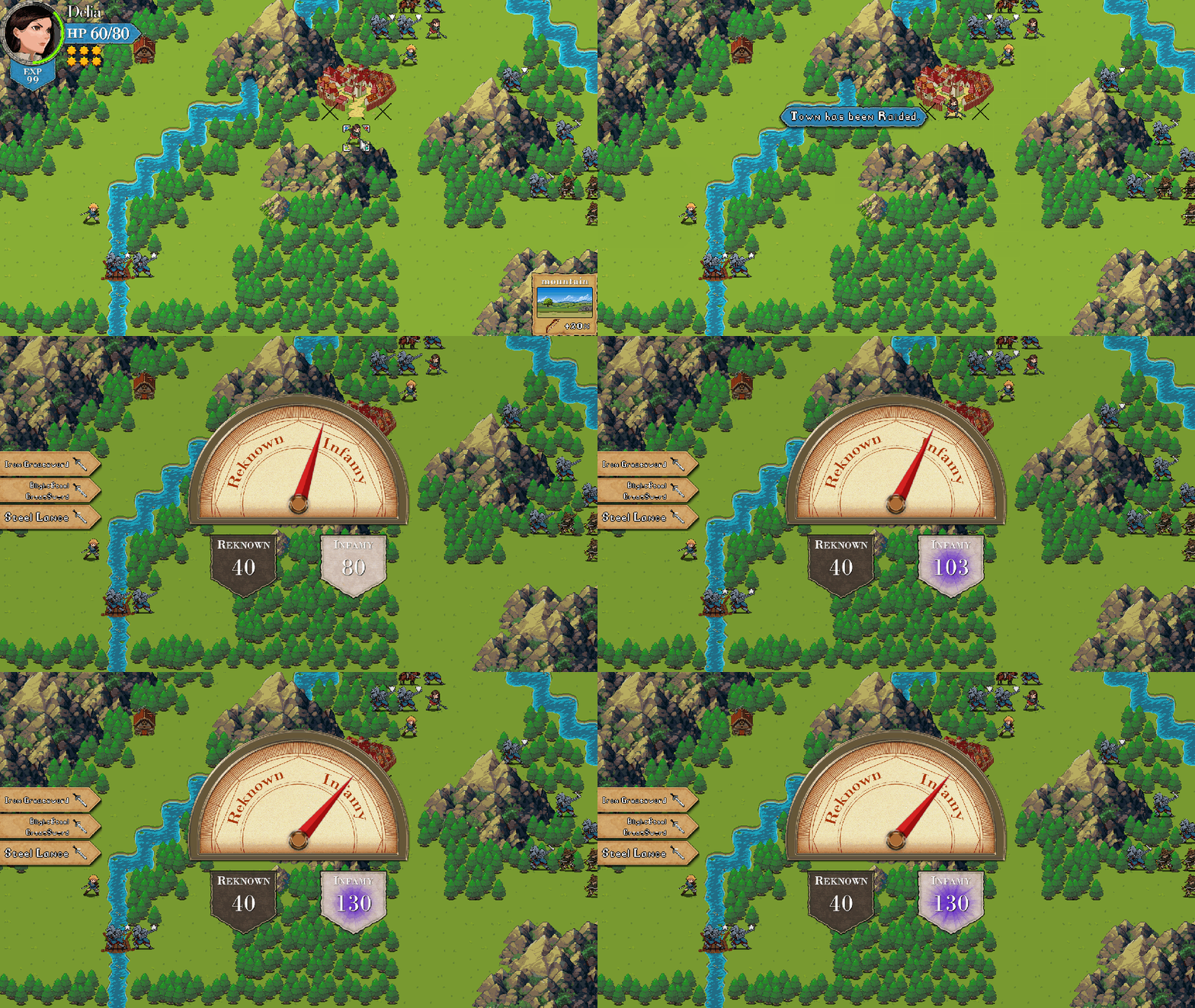
Village raiding allows your units to pillage any friendly NPC/town, to obtain items that are normally sold in that towns shop. This allows players to obtain items without spending any silver. Items in shops are separated into tiers and categories, and there is a Random Roll that picks an item from each tier/category.
This mechanic allows certain units to become powerful early on, serving as an additional artificial difficulty setting, but comes at the cost of player Doing so, results in the infamy stat to go up, which affects a number of things in the game, like story, which units become recruitable and the price of items in other shops.
The inclusion of village raiding is primarily to add extra variability in story, but also for players to min/max playthroughs, because as of this post, items in each shop are static and not randomly generated.
Village raiding is one mechanic in the large Reknown/Infamy system. The other mechanics related to reknown such as dueling are still a work in progress but aims to create a balanced good/evil system, to add replayability to the game, as it changes the story and which characters become available throughout a playthrough.
Quality of Life Changes for FE style games
A number of small changes that have been added for quality of life. Most of these are just things I wish existed in every FE game I’ve played, but in particular the GBA games.
Showing Enemy Attack Squares and threat level
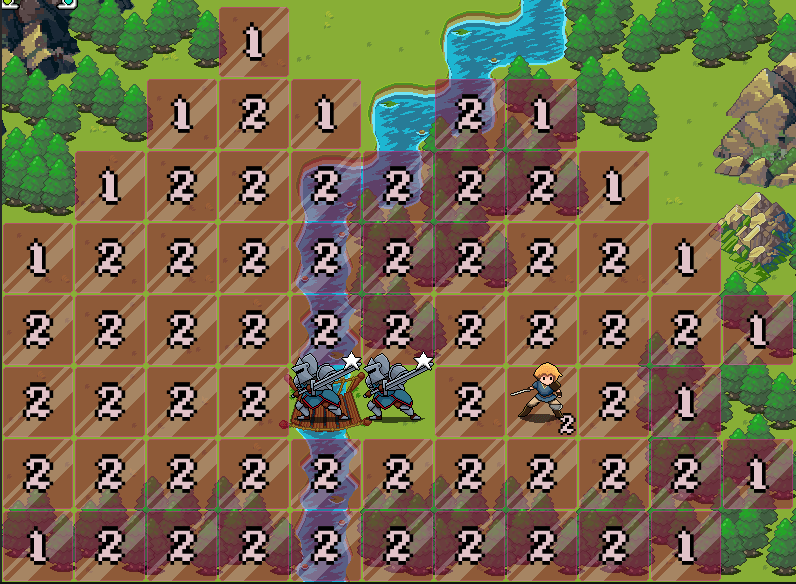
Above shows the attack squares for enemy units. This exists in modern FE games, where I first saw it in FE Awakening, but I’ve taken a step further by actually adding numbers that indicate the threat level of each square. The numbers indicate how many enemy units can move to that square to attack. I felt this has even increased importance when combined with the Flank system used by both the players and enemies for attacking.
Show Support Letters
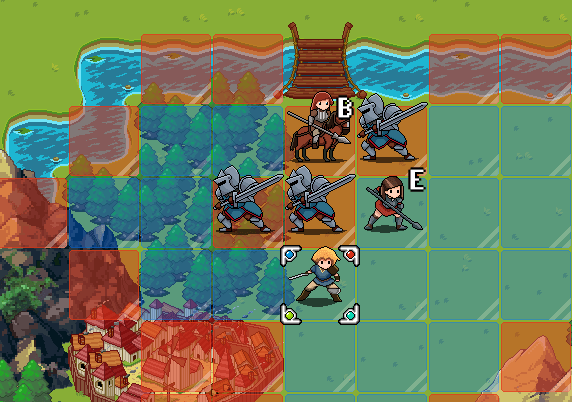
When a player unit is selected to perform an action, all allied units will display their support rank with that unit. Some of the supplementary game mechanics such as blocking/flanking increases the incentive to group/pair units together and have them develop a rapport throughout the game. Showing the support rank is a much needed addition to know which units should be placed near each other for a significant advantage.
Show Enemy AI

The enemy unit behaviours in FE games have never been super complicated and are pretty much split into 3 main types:
- Enemy Unit will remain stationary until a player unit moves within range. (Most common)
- Enemy Unit Will not move (usually defending a choke point)
- Enemy Unit will move in direction of player units as soon as the level starts
The Icons shown in the picture above denote each of these behaviours. I never saw a point in obfuscating this information from the player. Knowing the specific behaviours of different types of units and on specific maps only provided a reward for players that had already completed those levels at least once. The choice to make the enemy unit behaviour obvious is solely to service new players.
Coming Posts
This post covered some of the more finished additions to the game. By the end of writing this it did actually help me realize changes I want to make in other features, particularly with UI.
Next Post will detail the changes to the battle system and the UI changes, and the post after that will cover some of the new UI screens related to out-of-level gameplay. As stated above, the posts will no longer be weekly as they once were, but as things finish. This is due to the state of the project changing, where there is now enough finalized designs and concepts, and the topics will be covering more how they piece together into something actually playable, whereas before the posts from 2017-2019 were more about process discovery.