Writing, Art and Engine Migration
The last year and a half started with finally writing the main narrative of the story and characters which basically ended up with alot of art having to be redone. There had been very little actual narrative writing finalized as the hobby thus far had just been to find out if I would be able to build the kind of game I wanted to make. The main point of doing the writing was to be able to come up with a minimum playable demo that I could start designing, as most of the actual gameplay features/system had been completed in Unity.
Unfortunately in September of last year, the unit pricing debacle made me lose confidence in sticking with that platform, specifically because it is my intention of releasing a free downloadable demo at some point. Although the changes were rolled back, it still convinced me that it was worth my time to learn more than one game engine, so I could have more perspective on how to build games in general.
Migration to Unreal Engine from Unity
When looking up tutorials for Unreal, it felt immediately noticeable that the tutorial/youtube community for unreal, but more specifically indie 2D games was underdeveloped compared to Unity. I was VERY lucky to find Alex Quevillon’s Youtube tutorial series that instructs how to build a tactical RPG. Compared to most narrated tutorial series I’ve followed, the depth and format of the tutorials were very thorough, so a big thanks to Alex Quevillon for not only putting out a detailed series from Project Repo Setup all the way to Marketplace setup, but even releasing the entire thing in both English and French.
I mostly used the tutorial as a way to understand Unreal workflow, especially with how it shows how event dispatchers are used. This is a huge departure in programming design from what I had developed in unity, where all player input are processed by a singleton state machine. After completing Quevillon’s 60+ video series, I’m now currently in the process of repurposing this starting point of an Unreal tactics game back into the Fire Emblem style ruleset and game mechanics I had built in Unity.
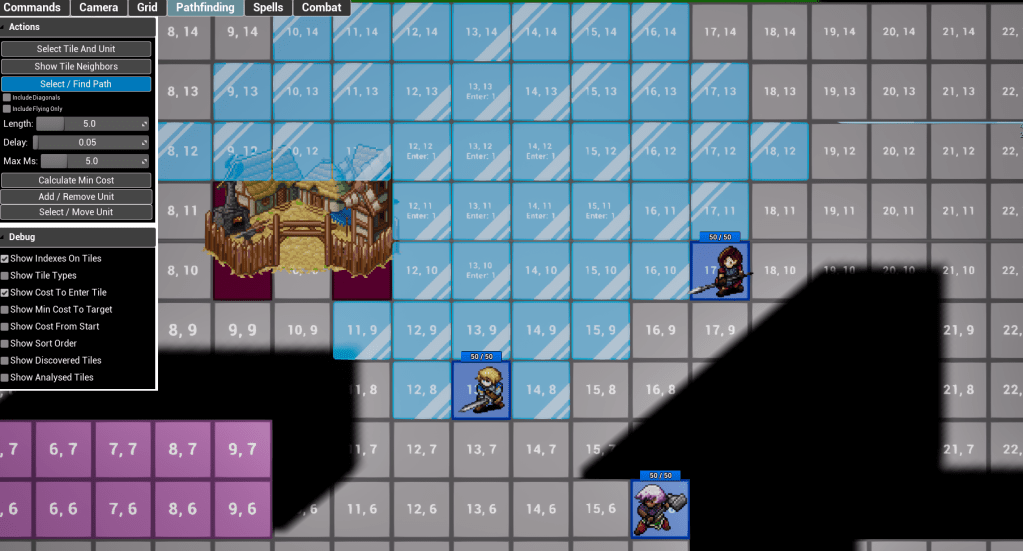
Although the migration was a lot of steps backwards at the start, many of the features from Quevillon ‘s tutorial series have been massive improvements to the overall design process. Particularly the inclusion of debug tools have been helpful in iterating quicker on how things like AI and movement should work, and in general thinking about how to build features with debugging tools in mind. Below shows the placement of units from the tutorial but with replacing the Visual meshes with Paper sprite assets from the Unity build.

Although most unreal engine features were available in unity too, revisiting stuff like camera functionality and UI through Quevillon’s tutorial has given me more thoughts of having 2.5D features in the game instead of locking it to purely top down. Below is an example of billboarding where the sprites always face the camera. I’m hoping to evolve this with more visual effects like hand-painted normal maps and transition from unlit sprites to a dynamically lit scene. The billboarding does not really have a gameplay purpose in tactics games like Fire emblem where there is only one tile elevation, and camera control is not necessary to observe the game board properly. Most likely just going to use 2.5D cameras for transition effects between unit control and battle animations.
One huge improvement I appreciate from Quevillon’s tutorial series was how he handled the pathfinding algorithm performance. In my unity build I had a much less elegant solution to per frame processing, where I had hardset a number of operations allowed per frame to get rid of frame stutters, but Quevillon’s millisecond delay ended up being more flexible for my needs.

PixelArt Improvements
Another rehaul of the pixel art has been underway the past year due to a few games with really great pixel art that came out: Songs of Conquest, Triangle Strategy and Octopath Traveler 2. Previously the 1×1 single pixel blocks being used were sensitive to rendering artifacts when the camera was not perfectly sized to the monitor resolution. The main “rehaul” was having pixel art in 2×2 size pixels worked better with changes in camera zoom and just looked more appealing in general.
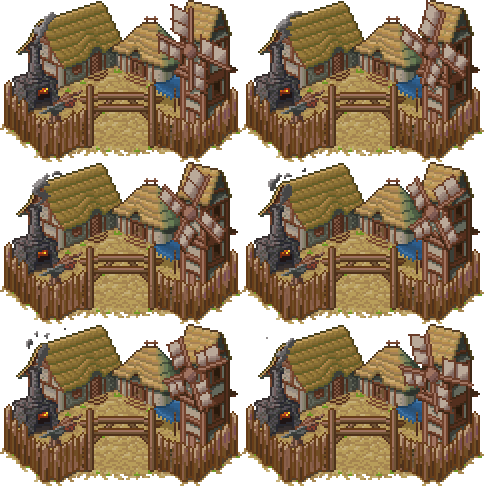


Songs of Conquest in particular has been great to study from for all environmental pixel art and all three games in particular have great 2.5D visual effects. It is also very motivating that TS and OT2 are made in unreal engine.
Adaptations in Portrait Art and 2D battle
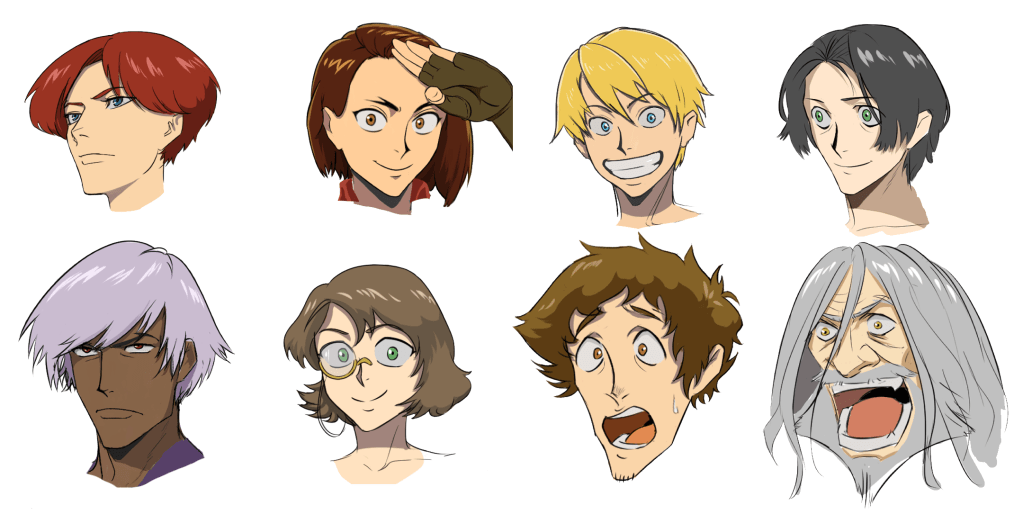
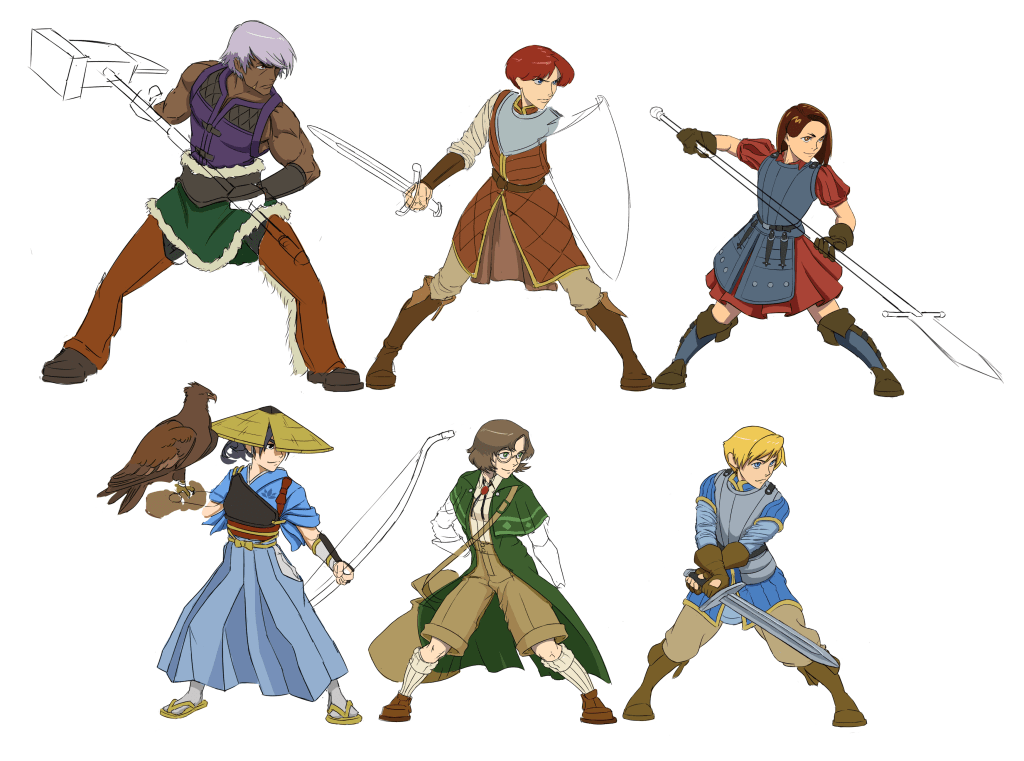
As mentioned previously, having character writing done allowed me to finalize things like custom design for a number of the main cast, and also allowed me to progress my art in way that it better serves how I want the game to feel. In previous iterations I had felt that it was an issue that doing character portrait art felt like such a completely separate task than doing battle animations. I realized what I wanted for doing character art in general to feel more cohesive, so I had to embrace a more anime portrait art style that was less heavily painted and rendered. So I spent alot of time redoing the character portrait art based off the new character writing and making sure that it basically didn’t look too different from the battle animations.
My focus now will still be to get the Unreal build back to the equivalent feature set that I had in Unity and using all the assets I had built over the years, particularly all the UI assets and their functionality. I may still switch back to Unity, as I’m still more comfortable with it and coding in Unreal blueprints is still somewhat unintuitive for me, despite already encountering much easier code debugging scenarios in general.
 To Reverie